Neural Circuits and Brainstem Control of Lower Urinary Tract Function
PROJECT — FROM SENSORY SIGNAL TO MOTOR ACTION
The brain coordinates sensory input from the lower spinal cord and pelvis with information from the external environment to ‘decide’ when to void by activating or inhibiting neurons in the brain’s pontine micturition center, aka Barrington’s nucleus.
We aim to identify the specific neurons that comprise i) the bladder-afferent activity circuits, including low- and high-stretch-sensing pathways, and ii) the continence-regulating brain “storage sites”, all of which are closely connected to the reflex micturition pathway.
The lab uses in vivo fiber photometry (1,2) to study the temporal sequence of Barrington’s nucleus (Bar) neuron activation. Furthermore, we use optogenetics, chemogenetics, conditional ablation, and tetanus toxin-mediated silencing of neurons to manipulate neural activity (3-6) and to understand how the bladder signal reaches Bar to drive voiding.
>> This project investigates which neurons detect, relay, and process the bladder distention signal, so that it ultimately becomes integrated into coherent neural control for proper bladder function. <<
- Funding: NIH-NIDDK, R01 DK125708 (Verstegen), 2020-2025, and R01 DK142807 (Verstegen), 2025-2030.
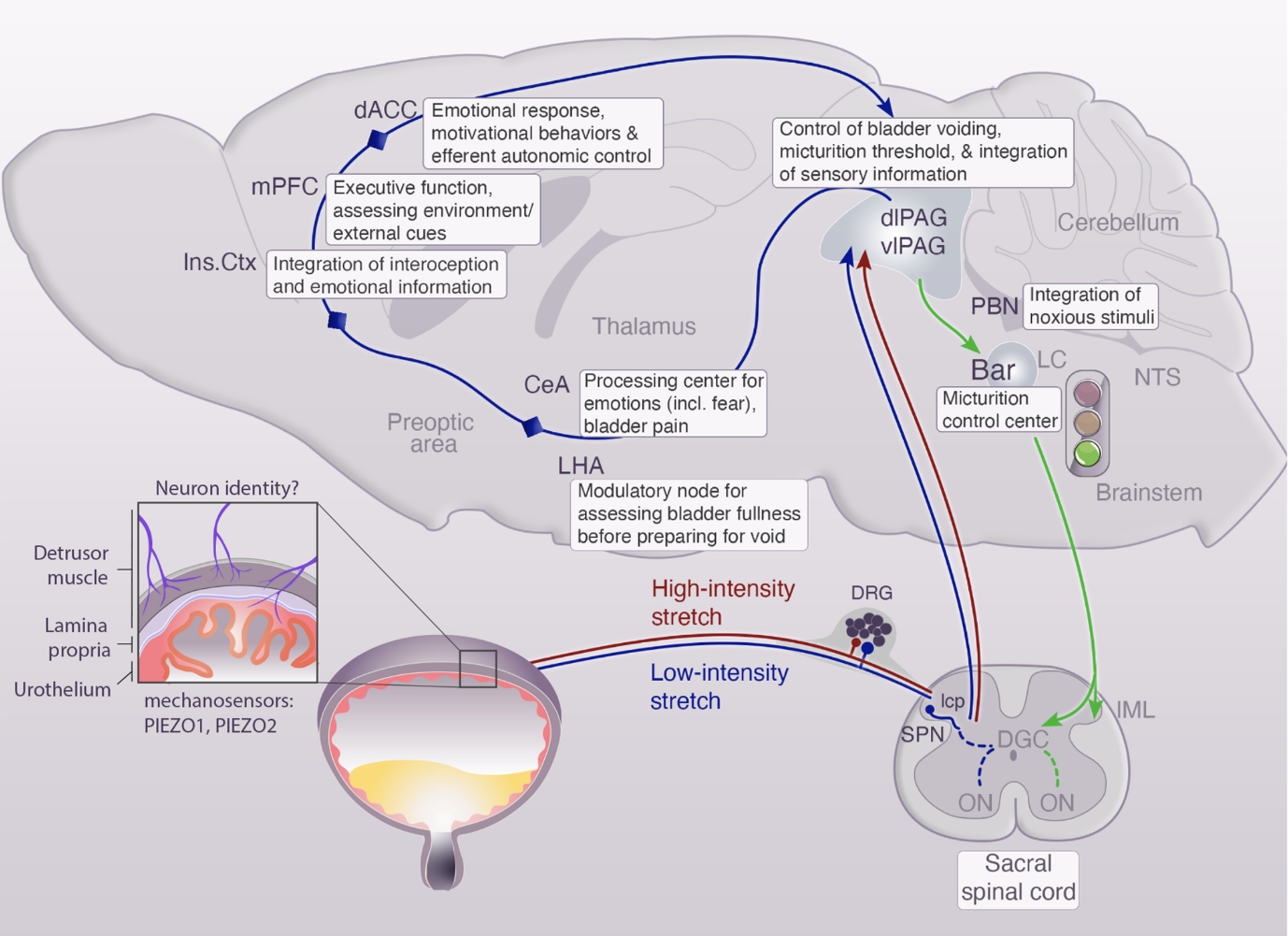
FROM THE BLADDER TO THE BRAIN:
How you know when it’s time to go
References:
1) Lin et al., 2016 - Genetically encoded indicators of neuronal activity. PMCID: PMC5557009
2) Chen et al., 2013 - Ultrasensitive fluorescent proteins for imaging neuronal activity. PMCID: PMC3777791
3) Deisseroth, 2015 - Optogenetics: 10 years of microbial opsins in neuroscience. PMCID: PMC4790845
4) Atasoy and Sternson, 2018 - Chemogenetic Tools for Causal Cellular and Neuronal Biology. PMCID: PMC5866359
5) Roth, 2016 - DREADDs for Neuroscientists. PMCID: PMC4759656
6) Anaclet et al., (2018) - Genetic Activation, Inactivation, and Deletion Reveal a Limited And Nuanced Role for Somatostatin-Containing Basal Forebrain Neurons in Behavioral State Control. PMCID: PMC5977448
Read more:

Schematic of ChR2-mCherry construct and viral targeting unilateral to a Barrington’s nucleus-afferent brain site.

Schematic of GCaMP6s construct and viral targeting unilateral to a Barrington’s nucleus-afferent brain site.